

Small Towns, Big Wounds: Why Rural Churches Keep Meeting Hidden Social Crises
Rural churches often face homelessness, addiction, and family instability before anyone else sees the pattern. Small towns hide pain differently, not less deeply.
Rural communities can look steady from the outside while carrying deep strain underneath. In small towns, pain often stays hidden longer. Housing instability does not always look like a sidewalk encampment. Addiction does not always announce itself in public. Family collapse often gets covered by relatives, friends, and church people who keep things moving one more week at a time.
That is one reason rural churches so often become the first place where trouble is noticed. A missed conversation turns into a crisis call. A prayer request becomes a grocery run. A quiet family situation becomes a funeral, an eviction, or a child suddenly living with grandparents.
This is not because rural places are uniquely broken. It is because rural pain is often less visible, more relational, and harder to separate from everyday life.
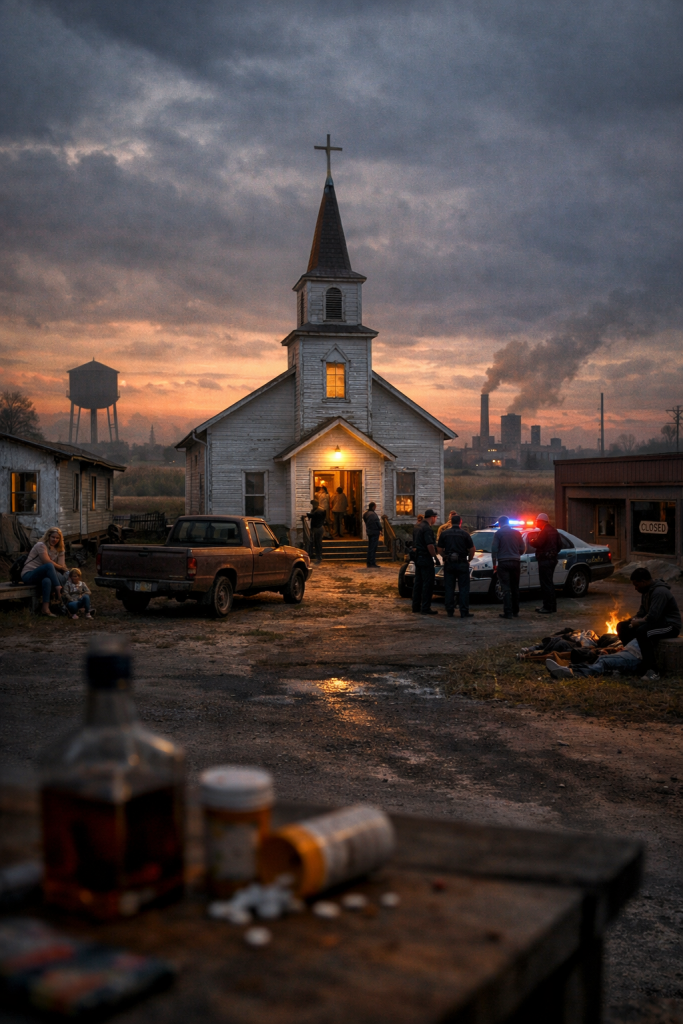
Small towns do not lack social problems
They often lack the systems that make those problems visible. Research on rural homelessness repeatedly notes the hidden nature of housing instability in nonurban places. People are more likely to rotate between couches, stay in overcrowded homes, live in vehicles, camp in isolated places, or remain in substandard housing rather than appear in the kinds of public settings people associate with homelessness in larger cities. The National Alliance to End Homelessness and the Housing Assistance Council both note that rural homelessness is often undercounted for exactly this reason.
That matters for ministry. If leaders only recognize a problem when it looks urban, they will miss much of what is happening in rural communities. That insight lines up with broader Rural Think Tank concerns about small town demographic shifts and the way leaders can keep ministering to a version of the community that no longer fully exists.
Addiction and instability spread through relationships
Rural addiction is not just a personal struggle. It affects transportation, employment, parenting, school attendance, family trust, and church participation. The Rural Health Information Hub, drawing on SAMHSA and related sources, shows that nonmetro communities continue to face significant substance use pressures alongside thinner treatment infrastructure. When services are farther away, waitlists are longer, and privacy is harder to maintain, the burden shifts back onto families and local institutions.
That means a pastor may end up carrying conversations that in a better resourced community would be shared by counselors, recovery staff, social workers, and case managers. Churches cannot replace those roles, but they should understand why people keep arriving at their doors.
The church often becomes the first responder by default
In some rural places, the church is one of the last institutions still trusted enough to hear the truth. That does not make the church a full social service agency, but it does mean church leaders should expect to encounter housing instability, addiction fallout, caregiving strain, and mental health stress long before a formal system responds.
Faith based organizations have long played a meaningful role in social service delivery, especially where local capacity is thin. That does not mean every church needs a large formal program. It does mean churches should take seriously the stewardship of trust, presence, and proximity. In that sense, this article also overlaps with Rural Think Tank’s older language about community missionary presence.
What rural churches can do first
- Learn the real pressure points in the community, not just the public stories.
- Broaden the definition of homelessness to include doubled up and unstable living situations.
- Train volunteers to listen, document, and refer instead of guessing.
- Build a short practical list of local and regional contacts for treatment, shelter, counseling, and transportation help.
- Recognize that repeated emergencies usually point to deeper structural strain.
Rural churches do not have to solve everything in order to respond faithfully. But they do need to see clearly. Small towns can hide big wounds. Ministry gets wiser when leaders stop mistaking invisibility for health. Churches that need a practical next step should also consider the framework in What Faithful Ministry Can Actually Do When the Need Outruns the Town.
Related reading
If this theme resonates, it connects naturally with earlier Rural Think Tank reflections on community missionary thinking, reaching out into your community for impact, and rural caregiving as hidden infrastructure.